
Blog
China Best Machine Safety Fence Manufacturer?
Choosing the China best Machine Safety Fence manufacturer requires more than comparing prices or browsing polished product photos. A reliable supplier should understand risk assessment, guarding design, access control, and long-term factory conditions. The fence must withstand impact, prevent unintended access, and support safe maintenance without creating new hazards.
Dr. Nancy Leveson, a leading safety-engineering authority, has said, “Safety is an emergent property of systems.” This principle applies directly to every Machine Safety Fence project. A strong panel alone cannot protect operators. The complete system should include rigid posts, secure fixings, properly positioned doors, and suitable interlocks. Mesh openings must match the machine’s hazard zone and required safety distance. ISO 14120 and ISO 13857 can provide useful design references, while local workplace requirements still need careful review.
Look closely.
An experienced Chinese manufacturer should provide clear drawings, material specifications, load information, and inspection records. Ask how the company controls welding quality, coating thickness, dimensional accuracy, and replacement-part availability. Visit the production line when possible. A clean workshop helps, but traceability matters more. Request samples before approving a large order.
The best supplier is not always the cheapest. A low quotation may exclude installation guidance, custom brackets, or future support. That detail can become expensive later. I have also seen attractive safety fences fail because door alignment was treated as an afterthought. This is an important limitation in many buying decisions. A dependable manufacturer combines practical engineering, transparent communication, documented testing, and a willingness to question unsafe assumptions. That is where confidence begins.
What Is a Machine Safety Fence?
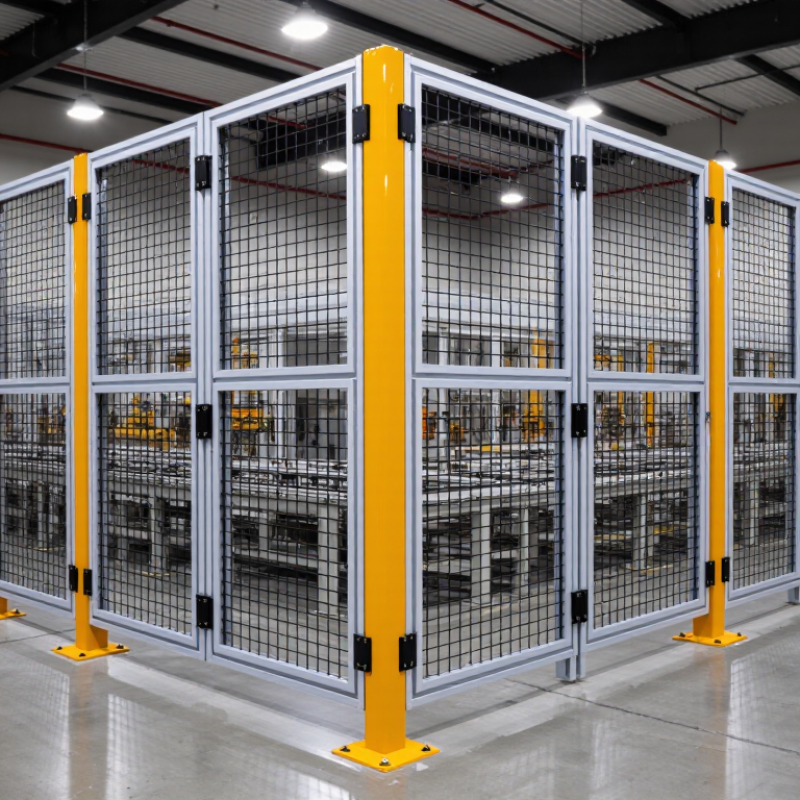
A machine safety fence is a physical barrier around hazardous equipment. It separates people from moving parts, robots, cutting tools, and automated lines. Typical systems include steel mesh panels, posts, access gates, hinges, locks, and safety switches. The mesh allows operators to see the process while preventing hands from reaching dangerous zones.
The design must match the machine’s actual risks. OSHA standard 29 CFR 1910.212 requires guarding for points of operation, rotating parts, and other mechanical hazards. A suitable fence should resist impact, maintain a controlled distance, and prevent easy climbing or reaching. Gates often connect with interlocking devices, stopping motion when opened. Small details matter. A poorly positioned latch can undermine an otherwise strong enclosure.
The International Labour Organization reports about 2.78 million work-related deaths annually worldwide, including incidents and occupational diseases. This figure covers many hazards, but it shows why physical risk control deserves careful attention.
During site inspections, engineers should check visibility, emergency access, cleaning space, and maintenance routes. A fence that blocks every service task may be removed by workers. That is a real design failure. Manufacturer selection should therefore consider tested materials, documented load performance, installation guidance, and compatibility with the machine’s control system. Thin wire, weak posts, or unclear drawings can create problems long after delivery.
Key Features of China’s Best Machine Safety Fences
China’s best machine safety fences combine strong protection with practical access. The frame should use rigid steel posts and welded mesh panels. Mesh openings must follow ISO 13857 reach-distance principles. This prevents hands and tools from reaching hazardous moving parts. Clear visibility also matters. Operators need to see the machine without opening the guard.
Reliable systems use modular panels, adjustable feet, and lockable access gates. Safety switches should monitor gate position and stop equipment when entry occurs. ISO 14119 provides guidance for interlocking devices, while ISO 14120 addresses guard design and construction. A durable powder-coated surface helps resist oil, moisture, and factory abrasion. Small details matter.
The ILO’s 2023 report estimates nearly three million work-related deaths worldwide each year. It also records about 395 million nonfatal work injuries. These figures show why machine guarding cannot be treated as decoration. Installation quality is equally important. A strong fence can still fail when a gate is misaligned or a gap is overlooked. No fence is perfect. Regular inspections should check bolts, hinges, switches, and damaged mesh. In my experience, visibility and maintenance access are often underestimated, although both affect daily safety behavior.
China Best Machine Safety Fence Manufacturer? - Key Features of China’s Best Machine Safety Fences
Panel heights of 1,000–2,000 mm are commonly used in modular machine guarding systems. The final height, mesh opening, access-door design, and clearance should be selected through a machine risk assessment and verified against applicable requirements such as ISO 14120 and ISO 13857.
How to Evaluate Chinese Safety Fence Manufacturers
China Best Machine Safety Fence Manufacturer?
How to Evaluate Chinese Safety Fence Manufacturers
A reliable evaluation starts with the factory, not its website. Ask for current production photos, workshop addresses, and a video inspection. Check whether cutting, welding, coating, and assembly occur under controlled conditions. Request material certificates for steel wire, posts, clamps, and doors. Thin wire may look acceptable but bend during installation. That detail matters.
Review drawings against your machine layout and applicable safety requirements, including guarding distance and access control. A capable manufacturer should explain mesh openings, panel height, anchor spacing, and emergency access clearly. Request test records for weld strength, coating thickness, and door-cycle performance. Documents must match the supplied product. During a factory audit, compare labels, batch numbers, and inspection forms. Small inconsistencies deserve questions.
Communication reveals technical maturity. Ask for a sample panel before approving a large order. Measure its wire diameter, frame squareness, surface finish, and connector fit. Confirm packaging with photographs showing corner protection and moisture control. Clarify replacement parts, installation guidance, and response times in writing. A low quotation can hide weak coating or costly modifications. I would not treat a polished catalog as proof of competence. That assumption is tempting, but incomplete. Evaluate evidence, not promises.
China Best Machine Safety Fence Manufacturer? - How to Evaluate Chinese Safety Fence Manufacturers
| Evaluation Dimension | What to Evaluate | Reliable Technical Reference or Target | Evidence to Request | Suggested Weight | Evaluation Result |
|---|---|---|---|---|---|
| Compliance with Safety Standards | Whether the fence system is designed as a machine guard and integrated with the machine risk assessment. | Check design alignment with ISO 14120 for guards and ISO 13857 for safety distances. | Declaration of conformity where applicable, technical file extracts, risk-assessment documents, and test records. | 20% | Pass only when documents match the supplied configuration and intended application. |
| Guarding and Access Control | Panel height, mesh or opening size, clearance from hazardous movement, door locations, and access routes. | Opening sizes and separation distances must be selected according to the hazard and the reach-distance tables in ISO 13857. | Layout drawings, opening-size schedule, clearance calculations, and photographs of a comparable installation. | 15% | Reject generic dimensions that are not supported by a machine-specific layout. |
| Interlocking and Safety Switch Compatibility | Mechanical door design, hinge direction, lock provisions, trapped-key options, and compatibility with safety switches. | Interlocking arrangements should be assessed with ISO 14119 and the machine control-system requirements. | Door hardware drawings, switch-mounting details, actuator alignment tolerances, and functional test procedure. | 15% | Confirm that opening a door initiates the required safety function and prevents unexpected restart. |
| Material and Corrosion Protection | Panel wire, frame, posts, brackets, fasteners, weld quality, surface treatment, and environmental suitability. | Common finishes include painted steel, powder-coated steel, and galvanized steel; hot-dip galvanizing can be specified with ISO 1461 where applicable. | Material certificates, coating specification, coating-thickness records, salt-spray results when required, and fastener grade information. | 10% | Select the finish according to humidity, chemicals, washdown conditions, and indoor or outdoor use. |
| Structural Performance | Resistance to normal impact, panel deflection, post stability, anchoring, and accidental contact during operation. | Performance should be verified for the foreseeable forces identified in the risk assessment; there is no universal load value for every machine guard. | Engineering calculations, finite-element analysis where appropriate, impact-test method, anchor details, and installation instructions. | 10% | Use application-specific evidence rather than accepting an unsupported impact rating. |
| Customization and Layout Accuracy | Ability to produce straight panels, corner sections, sliding or hinged gates, pass-throughs, and uneven-floor solutions. | The final layout should reflect the machine footprint, maintenance zones, emergency exits, utilities, and required safety distances. | Approved 2D or 3D drawings, bill of materials, revision history, tolerance schedule, and sample shop drawings. | 10% | Prioritize suppliers that use controlled drawings and obtain written approval before production. |
| Manufacturing Quality Control | Control of incoming materials, welding, dimensional accuracy, coating, assembly, packaging, and final inspection. | A documented quality system should provide traceability from purchase order and drawings through final inspection. | Quality manual, inspection and test plan, welding procedure records, nonconformance process, and pre-shipment inspection report. | 10% | Give preference to measurable inspection criteria instead of visual-only acceptance. |
| Installation and Maintainability | Assembly sequence, anchor access, replaceable panels, door adjustment, spare parts, and maintenance access. | The guard should remain effective after foreseeable maintenance activities and permit safe access to service areas. | Installation manual, torque specifications, anchor schedule, replacement-part list, and maintenance instructions. | 8% | Check installation time, adjustment method, and whether special tools are required. |
| Packaging and Export Readiness | Protection against corrosion, deformation, moisture, missing hardware, and identification errors during international transport. | Packaging should be suitable for the selected transport method, storage period, climate, and handling conditions. | Packing specification, carton or crate list, component labels, loading photographs, and damage-claim procedure. | 5% | Confirm that every package is traceable to the approved bill of materials. |
| Commercial and After-Sales Support | Quotation clarity, delivery schedule, warranty terms, technical communication, spare-part availability, and complaint response. | A quotation should clearly identify quantities, specifications, exclusions, delivery terms, inspection conditions, and warranty scope. | Detailed quotation, contract terms, warranty policy, communication records, and service escalation process. | 7% | Score based on documented commitments rather than verbal promises. |
Manufacturing Standards and Quality Control
China Best Machine Safety Fence Manufacturer?
Manufacturing Standards and Quality Control
A dependable machine safety fence begins with risk assessment, not attractive steelwork. The International Federation of Robotics’ World Robotics 2024 report recorded 541,302 industrial robot installations worldwide in 2023. More automation requires more disciplined guarding. Manufacturers should design fences around ISO 12100 risk assessment principles, ISO 14120 guard construction, and ISO 13857 safety distances. Each panel needs stable mesh, smooth edges, secure posts, and correctly positioned access points. A small opening can create a serious weakness.
Quality control must continue beyond incoming material checks. Inspectors should verify wire diameter, mesh dimensions, weld strength, coating thickness, anchor alignment, and door interlocks. Production records should link every batch to test results and inspection dates. The U.S. Bureau of Labor Statistics recorded 5,283 fatal work injuries in 2023. That figure does not measure fencing failures, but it shows why traceable safety decisions matter. Practical audits often uncover uneven welds or anchors installed on unsuitable floors. No checklist is perfect. Human review still matters.
Tips: Request material certificates and dimensional inspection reports. Check sample panels under realistic vibration and impact conditions. Confirm that gates close reliably after repeated use. Ask for installation drawings, maintenance guidance, and corrective-action records. A lower price may hide thinner wire, weaker welds, or incomplete documentation. Reliable manufacturers explain these limits clearly, even when their process needs improvement.
Choosing the Right Machine Safety Fence Supplier
Choosing the Right Machine Safety Fence Supplier in China
Selecting a machine safety fence supplier requires more than comparing prices. The supplier should understand guarding risks, operator movement, maintenance access, and production conditions. Ask for technical drawings, material specifications, and previous project details. Experience matters.
Inspect the fence construction carefully. Check wire diameter, mesh openings, post thickness, door hinges, and locking points. Welds should appear even and clean. The coating should resist scratches, oil, and routine cleaning. Fit matters. A small alignment error can delay installation.
Request samples, inspection records, and clear production timelines. Ask how the supplier handles design changes, damaged parts, and replacement requests. Communication is often more important than a polished catalog. Ask for proof. A factory visit or video inspection can reveal storage problems, weak packaging, or inconsistent workmanship. Do not guess.
A reliable supplier should review your machine layout before quoting. They may identify blind spots near conveyors or unsafe gaps beside doors. This practical review shows professional responsibility. However, no supplier is perfect. One overlooked access point can still appear during installation. Leave room for correction. Confirm dimensions again before production, especially around sensors, control panels, and emergency access areas. Clear records, careful testing, and honest responses create a safer purchasing decision.
